

9.8.09
The Tragedy of The Greek Apathy by Iason Athanasiadis
Moving back to Athens in 2003, I found a society living in denial. Greeks were skimming the cream off the last rounds of EU subsidies oblivious to the tidal wave of globalisation looming over them.
I had been living in Qatar, the very definition of a globalised city-state. The return home was a welcome respite from the Arab peninsula's identikit steel-and-glass cities, where city centres had been abolished in favour of income-appropriate super-malls and the pursuit of business was supreme. On my first night in Athens, I sat in a leafy square and watched young couples enjoy ouzo and mezze as children played under the lemon trees.
Some of those same children may have been torching the municipality's Christmas tree last week or chucking petrol bombs at its parliament.Greece's student intifada erupted over the shooting by a policeman of a 15-year-old student, but the anger and lasting power of the riots imply a deeper malaise.
The violence and nihilism with which banks, government buildings and private cars were burned down wrong-footed the older generation. But after the smoke cleared, there was a self-conscious pause as both sides waited for lucid demands to be made.
"Who if anyone is emerging?" asked Simon Baddeley, an honorary lecturer at Birmingham University's School of Government and Society in the UK, who offers coverage of the crisis through his Democracy Street blog. "The ideological stuff I've heard so far seems juvenile. Any new ideas would have surely to come linked to a set of workable economic and social ideas that don't look like the ones I'm hearing," Baddeley says.
Commentators speculated that the street spectacle was the logical conclusion of an alienated age group who realise that €700-a-month salaries are the most they can hope for as they approach maturity and are released from the parental embrace. But this did not jive with the contempt being expressed towards all sections of society (as well as the reality that many Greek parents support their children well beyond the point of maturity).
Columnist Giannis Pantelakis writing in the Eleftherotypia daily best crystallised the sense of bafflement when he rhetorically asked who the youths throwing petrol bombs were:
Are they the fast food delivery kids? Maybe children raised in an environment of professional insecurity, flexible working conditions and €400 monthly incomes? Are they the kids of 50-year-old parents dismissed from defunct factories and collapsing textile plants? Did they arm themselves with university degrees only to now queue outside government unemployment bureaus? Are they those who grew sick of a political system based on nepotism and family connections? Are they, after all, our own kids? Those kids who don't want to resemble us as we chase visions of semi-detached houses and Mercedes cars? Children who don't want to waste their lives as we did?"
Others waxed lyrical about a new Paris uprising timed to perfection with the 30th anniversary. But unlike Paris, the sound of broken glass and exploding petrol bombs was not overlaid by reasoned oratory.
"Have you heard any voice of substance from those who hold the streets," asks Baddeley. "Men or women of the potential of Cohn-Bendit, Rudi Dutschke, Petra Kelly, Angela Davis, Mario Savio and others?"
This generation feels mistreated and disrespected. But aside from knee-jerk demands to disarm the police, they lack thought-through policy proposals or just inspirational rhetoric. The students want a new government but they forget that the present one was voted in on a mandate of change after two decades of corruption by its predecessor. It is clear that the entire system needs overhauling and the party bosses' sclerotic, nepotistic hold broken.
Even in 2003, when the Greek stock exchange rode high and society swam in a haze of material acquisition, there were signs that the end was coming: rising crime and creeping societal breakdown skulked the streets of Greece like the growing crowds of beggars clustering at traffic lights. In central Athens, entire commercial districts gradually turned into immigrant neighbourhoods. Despite negative demographic growth, Greece's population of 10 million grew by a million as new arrivals flooded in from Africa, the Middle East and Asia. Around Athens, racist posters appeared showing a scared-looking child saying, "When I grow up Greece will have 3.5 million foreigners. STOP IT."
As a new culture of private television channels beamed glamorous gameshows and soaps into living rooms, indoctrinating children in the ways of material wealth, the spending continued. With the Greek economy pummelled by Chinese imports, much of the splurge was on credit, and by 2005, the National Bank of Greece estimated that the daily rate of increase of credit card debt was €5.3m.
Perhaps none of this was different to what happened across western Europe other than the rapidity with which it swept through Greece. For a peasant society that exported immigrants until the 1970s, it was too much. Coming on the heels of 40 years of socially confusing urbanisation, the consumerist wave stultified a new generation of city-dwellers. They skipped school to attend brand-new arcades or joyride with their friends on shiny motorbikes.
The legacy of a discarded generation unencumbered by social responsibility is apparent in the ease with which the anarchists hijack peaceful demonstrations, the nihilistic tactics they employ and their tolerance by society at large. Charismatic student leaders may be incubating but they have yet to emerge. Instead of evocative revolutionaries, the marches feature plump middle-class kids costumed in the "alternative" fashions dictated by international marketing. Bleached blonde teenage girls tap away on colour-customised mobiles in between slogans.
Inspirational student demonstrations marked the 10-year anniversaries of Paris 1968: there were anti-Shah riots in 1978 in Tehran, pro-democracy marches in Burma in 1988, and more demonstrations – this time against the Islamic Republic that succeeded the Shah – in Tehran in 1998. So far, the Athens commotions have failed to capture the imagination of observers or to suggest we are on the verge of a new epoch in Greek politics. It marks a social failing, not just for the teenagers on the streets, but for us Greeks as a whole.
5.8.09
Summer Favourites No.II
 Men dancing at the revival of the fair... just magic
 Alison Damianos' from the Meet Market and mine birthday 'lion' cake. 29.7.81
The god forsakes Antony
2.8.09

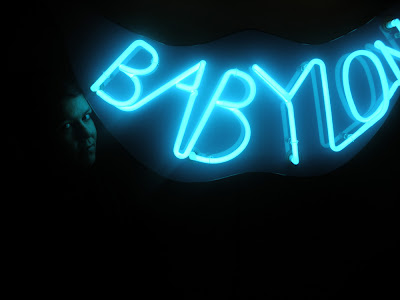
Summer Favourites No.I
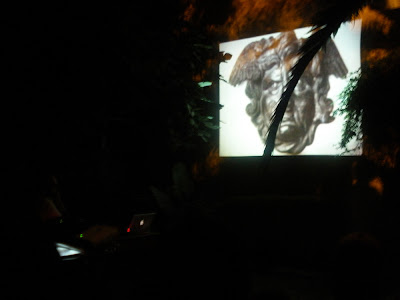 Simon And The Radioactive Flesh by Mark Aerial Waller and Giles Round at Marieke's Garden in Plaka, 16.6.9
 The End by Christodoulos Panayiotou at the Markgrafliches Opernhaus
in Bayreuth 27.6.9
The End by Christodoulos Panayiotou at the Markgrafliches Opernhaus
in Bayreuth 27.6.9
 Sunset from Chora before the storm 20.6.9
 Λουκάς Σερίτσας
 Μαρίκα rider
 With Angelo at the New Acropolis Museum
 Afrohypnotic audiovisual impro in Berlin by William Bennet (Whitehouse)
8.7.09
The Satrapy
3.7.09


26.3.09


14.12.08
On Greece by Akis Gavriilidis
If you are in New York, don't miss
 Kevin Schmidt, Sad Wolf (2006)
The figure of the pawn is, for some, the ultimate image of compromise. American psychiatrist Robert Jay Lifton coined the term ‘psychology of a pawn’ during his 1961 study of human behaviour in extreme cases of re-education, such as cults or the Chinese under the Cultural Revolution. In such cases, the implementation of a group ideology causes the individual to relinquish personal freedom in favour of servicing the greater cause. Curated by Mari Spirito, ‘Psychology of a Pawn’ at PARTICIPANT INC goes on to examine much more than just extreme behavioural models, as the exhibition advances into a general study of behavioural modification created by society. Behaviour in any group situation always constructs itself through the subordination of individual aims under a common group goal. Exhibiting works by Shai Azoulay, Gianluca and Massimiliano De Serio, Alex Israel, Linda Post, Kevin Schmidt and Corin Sworn, Spirito traces these behavioural codes into the realm of the everyday: from education to self-adjustment, traditions, subliminal messages and popular psychology.
The idea of correcting an outside perception though self-correction is examined in Linda Post’s sculptural video installation Glean (2008), comprising two monitors facing each other like mirrors. As if in conversation, the videos expose the intricate negotiations of an individual relating itself to the outside world. These studies consist of intense personal observation paired with constant re-adjustment - a learning scenario in a loop.
Kevin Schmidt’s video projection Sad Wolf (2006) depicts an arctic wolf in captivity. The video is projected from a homemade video projector encased by a dilettantishly put-together plywood construction. The video carefully follows an omega wolf which has been shunned by the rest of his pack, the survival of which depends on a sense of unity created through designating a single outsider. Yet the pack itself is captured in a zoo, an artificial construct created so as to mark otherness and grant a sense of unity to the viewers.
The centre-piece of the exhibition, Gianluca and Massimiliano De Serio’s film Arabic Lesson (2005) offers the viewer a very different view on the study of the Koran than is generally shown by the western media. Through repetition and imitation a young second-generation Moroccan boy studies in his Turin home. Mediated though Italian, the Arabic language becomes awkward while his movements in the mosque feel clumsy and strange; words, meaning and movements do not yet move in unison for him. The film reveals the difficulty of the preservation of traditions and culture in a word of multiple, overlaying cultures.
Alex Israel’s collages oscillate between propaganda and school pride. The small works in the style of building-size high-school murals advocate messages such as ‘Go Sheiks’ and ‘Praying hands’. Israel’s clever play with size and content reveals the effects that subliminal messages can have on its surrounding despite the message they carries.
‘Psychology of a Pawn’ offers a sinister vision of human group behaviour. It exposes the dangers of being part of societies, which gain their strength through a collection of communally agreed on truths, which if in question would eliminate the very basis of its existence. Without offering an easy way out, the exhibition leaves the viewer with the question of how to best preserve a sense of individualism while remaining part of a community, how to maintain a position of distance that allows for critical reflection and oppositional thought.
Anna Gritz, Frieze.
Kevin Schmidt, Sad Wolf (2006)
The figure of the pawn is, for some, the ultimate image of compromise. American psychiatrist Robert Jay Lifton coined the term ‘psychology of a pawn’ during his 1961 study of human behaviour in extreme cases of re-education, such as cults or the Chinese under the Cultural Revolution. In such cases, the implementation of a group ideology causes the individual to relinquish personal freedom in favour of servicing the greater cause. Curated by Mari Spirito, ‘Psychology of a Pawn’ at PARTICIPANT INC goes on to examine much more than just extreme behavioural models, as the exhibition advances into a general study of behavioural modification created by society. Behaviour in any group situation always constructs itself through the subordination of individual aims under a common group goal. Exhibiting works by Shai Azoulay, Gianluca and Massimiliano De Serio, Alex Israel, Linda Post, Kevin Schmidt and Corin Sworn, Spirito traces these behavioural codes into the realm of the everyday: from education to self-adjustment, traditions, subliminal messages and popular psychology.
The idea of correcting an outside perception though self-correction is examined in Linda Post’s sculptural video installation Glean (2008), comprising two monitors facing each other like mirrors. As if in conversation, the videos expose the intricate negotiations of an individual relating itself to the outside world. These studies consist of intense personal observation paired with constant re-adjustment - a learning scenario in a loop.
Kevin Schmidt’s video projection Sad Wolf (2006) depicts an arctic wolf in captivity. The video is projected from a homemade video projector encased by a dilettantishly put-together plywood construction. The video carefully follows an omega wolf which has been shunned by the rest of his pack, the survival of which depends on a sense of unity created through designating a single outsider. Yet the pack itself is captured in a zoo, an artificial construct created so as to mark otherness and grant a sense of unity to the viewers.
The centre-piece of the exhibition, Gianluca and Massimiliano De Serio’s film Arabic Lesson (2005) offers the viewer a very different view on the study of the Koran than is generally shown by the western media. Through repetition and imitation a young second-generation Moroccan boy studies in his Turin home. Mediated though Italian, the Arabic language becomes awkward while his movements in the mosque feel clumsy and strange; words, meaning and movements do not yet move in unison for him. The film reveals the difficulty of the preservation of traditions and culture in a word of multiple, overlaying cultures.
Alex Israel’s collages oscillate between propaganda and school pride. The small works in the style of building-size high-school murals advocate messages such as ‘Go Sheiks’ and ‘Praying hands’. Israel’s clever play with size and content reveals the effects that subliminal messages can have on its surrounding despite the message they carries.
‘Psychology of a Pawn’ offers a sinister vision of human group behaviour. It exposes the dangers of being part of societies, which gain their strength through a collection of communally agreed on truths, which if in question would eliminate the very basis of its existence. Without offering an easy way out, the exhibition leaves the viewer with the question of how to best preserve a sense of individualism while remaining part of a community, how to maintain a position of distance that allows for critical reflection and oppositional thought.
Anna Gritz, Frieze.
11.12.08
Phobos: Doomed Moon of Mars
 Explanation: This moon is doomed. Mars, the red planet named for the Roman god of war, has two tiny moons, Phobos and Deimos, whose names are derived from the Greek for Fear and Panic. These martian moons may well be captured asteroids originating in the main asteroid belt between Mars and Jupiter or perhaps from even more distant reaches of the Solar System. The larger moon, Phobos, is indeed seen to be a cratered, asteroid-like object in this stunning color image from the Mars Reconnaissance Orbiter, recorded at a resolution of about seven meters per pixel. But Phobos orbits so close to Mars - about 5,800 kilometers above the surface compared to 400,000 kilometers for our Moon - that gravitational tidal forces are dragging it down. In 100 million years or so Phobos will likely be shattered by stress caused by the relentless tidal forces, the debris forming a decaying ring around Mars.
NASA
Explanation: This moon is doomed. Mars, the red planet named for the Roman god of war, has two tiny moons, Phobos and Deimos, whose names are derived from the Greek for Fear and Panic. These martian moons may well be captured asteroids originating in the main asteroid belt between Mars and Jupiter or perhaps from even more distant reaches of the Solar System. The larger moon, Phobos, is indeed seen to be a cratered, asteroid-like object in this stunning color image from the Mars Reconnaissance Orbiter, recorded at a resolution of about seven meters per pixel. But Phobos orbits so close to Mars - about 5,800 kilometers above the surface compared to 400,000 kilometers for our Moon - that gravitational tidal forces are dragging it down. In 100 million years or so Phobos will likely be shattered by stress caused by the relentless tidal forces, the debris forming a decaying ring around Mars.
NASA

